
Chapter 2. Goodness Always Prevails (Grade 8)

In this chapter, you will learn about narratives, especially traditional tales. You will also learn English through the topic of Goodness Always Prevails. This chapter consists of two sections: Listening & Speaking and Reading & Writing.
A. Speaking & Listening
- Timun Emas.
- Malin Kundang.
- Students talk about “Si Pitung.”
- Students write a local storytelling about the origin of their village, regency, or city.
B. Reading & Writing
- The arrogant frog.
- Bawang Merah and Bawang Putih.
- Sura and Baya.
- Students tell about storytelling from their regions.
Before studying this chapter, it is recommended that you first relearn about Simple Past Tense.
Happy learning! 🙂
A. Speaking & Listening
Instruction 1:
Watch the following video of “Malin Kundang”. Pay attention to the expressions and vocabulary used. Take a note or make a list of the new vocabulary words. After watching video 1, answer the questions.
This video, created by Dongeng Kita, is embedded here for educational purposes. The original video can be found here: Folklore – Malin Kundang – English Version – ( EF – English First Version ). Copyright remains with the creator.
Questions:
Instruction 2:
Watch and listen to the following video of “Sangkuriang”. Pay attention to the expressions and vocabulary used. Take a note or make a list of the new vocabulary words. After listening, answer the question.
This video, created by Dongeng Kita, is embedded here for educational purposes. The original video can be found here: https://www.youtube.com/watch?v=HHRwxxHccjQ. Copyright remains with the creator.
Questions:
Instruction 3:
Make a script to tell about “Si Pitung”. The script is just for helping you to get ready to speak. The steps are:
a) Record your story telling on your mobile phones.
b) In the mobile app, fill in the blank space below by naming it Speaking Assignment_Si Pitung Storytelling (Your name).
c) Click the “browse” button and upload your audio recording.
B. Reading & Writing
Instruction 1:
Rewrite the new vocabulary in the following text, then look up their meanings in Bahasa Indonesia.
Traditional Tales as a Part of Narrative Text
Traditional tales are narrative texts passed down orally from one generation to another. These stories are deeply rooted in a community’s culture, history, and values, serving to entertain, educate, and preserve traditions. Traditional tales often include folktales, myths, fables, and legends, making them essential to narrative storytelling.
Why Are Traditional Tales Considered Part of Narrative Texts?
- Shared Purpose:
Like all narrative texts, traditional tales aim to tell a story—whether for entertainment, to convey a moral lesson, or to explain natural phenomena. - Similar Structure:
Traditional tales follow the same narrative structure:- Orientation: Introduces characters, setting, and context.
- Complication: Presents a problem or challenge.
- Resolution: The problem is resolved, often with a lesson learned.
- Use of Narrative Features:
Traditional tales include time connectors, past tense, dialogues, and descriptive language, making them a natural part of the narrative genre.
Characteristics of Traditional Tales
- Cultural Origins:
These stories often reflect the values, beliefs, and customs of the culture they come from.
Example: In Indonesian culture, the legend of Malin Kundang conveys the importance of respecting parents. - Moral Lessons:
Traditional tales usually aim to teach values or social norms.
Example: The fable of The Tortoise and the Hare teaches the importance of perseverance and humility. - Timelessness:
They are often set in a distant, undefined past, beginning with phrases like “Once upon a time…” or “A long time ago…” - Supernatural Elements:
Many traditional tales include magical or mythical components, such as talking animals, gods, or enchanted objects.
Example: In the Javanese story of Timun Mas, a magical cucumber gives birth to a child.
Types of Traditional Tales
- Folktales:
Simple stories passed down orally, often involving ordinary people and their struggles or cleverness.
Example: Si Kancil dan Buaya (The Mouse Deer and the Crocodile). - Myths:
Stories about gods, creation, and natural phenomena, often explaining the origin of things.
Example: Nyi Roro Kidul (The Goddess of the South Sea). - Fables:
Short stories with animals as characters, delivering a moral lesson.
Example: The Lion and the Mouse. - Legends:
Stories rooted in historical events but often exaggerated with fictional elements.
Example: Tangkuban Perahu (The Legend of Sangkuriang).
Example of a Traditional Tale as Narrative Text
Title: Bawang Merah and Bawang Putih
- Orientation: Bawang Putih, a kind-hearted girl, lives with her cruel stepmother and stepsister, Bawang Merah.
- Complication: Bawang Putih is mistreated and sent to do all the housework. One day, she helps an old woman and is rewarded with a magical gift.
- Resolution: Bawang Merah becomes envious and tries to get the same reward but is punished for her greed.
- Moral: Kindness and sincerity will always be rewarded, while greed and selfishness lead to downfall.
This text includes references to:
- The Role of Literature in Preserving Culture – Search My Post: Discover Guest Blogs. Retrieved from https://www.searchmypost.com/the-role-of-literature-in-preserving-culture/.
- Zoological Literacy – Cultural Ecology. Retrieved from http://blog.culturalecology.info/2024/08/01/zoological-literacy/.
Instruction 2:
Read the text below and answer the questions. Make a list in your book of new vocabulary and their meanings.
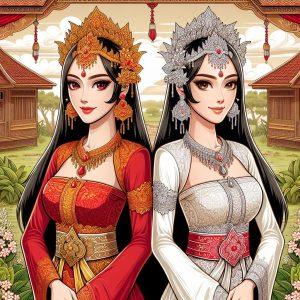
|
Bawang Merah and Bawang Putih “Shallot and Garlic”
Once upon a time, in a village, there were two sisters named Shallot and Garlic. They were stepsisters and lived in the same house. However, their personalities were very different. Bawang Merah (Shallot) was unkind, selfish, and jealous of her stepsister. On the other hand, Bawang Putih (Garlic) was kind and gentle and always helped others. Their mother loved Bawang Putih more because of her good nature. This made Bawang Merah even more envious. One day, their mother fell ill, and before she passed away, she told Bawang Putih always to be kind and helpful. After their mother’s death, Bawang Merah pretended to be kind, but in her heart, she was still jealous. One day, a prince from a nearby kingdom announced that he would choose a bride. Both sisters wanted to marry the prince. Bawang Merah, being cunning, went to a witch for help. The witch gave her a magical flower that made her appear more beautiful. Bawang Putih, however, relied on her good heart and did not seek any magical help. When the prince arrived, he was captivated by Bawang Merah’s beauty and chose her as his bride. Bawang Putih was heartbroken but remained kind and accepted her fate. The story twists when the prince discovers Bawang Merah’s true nature. She was unkind and selfish. The prince regretted his decision and went to seek Bawang Putih. He found her and realized that true beauty lies within a person’s heart. Bawang Putih forgave the prince and accepted him. They got married and lived happily ever after. The story’s moral is that kindness and a good heart are more valuable than outer beauty.
Questions:
Instruction 3: Read the text below and answer the questions. Make a list in your book for new vocabularies and their meanings. 
|
Questions: